Index markets compress the performance of many companies into a single price, giving traders a broader view of market direction. Their movement can reflect interest-rate expectations, economic releases, sector strength, corporate earnings, and changes in investor sentiment. Rather than evaluating one company at a time, traders can study how an entire market segment responds to changing conditions.
That broader exposure does not make trading straightforward, however. Index prices can accelerate rapidly around economic announcements, opening sessions, and shifts in global risk appetite. A capable indices trading platform therefore becomes part of the trading process by supporting chart analysis, order management, market monitoring, and disciplined execution.
Why Index Price Movement Requires a Wider Market View
An index represents a basket of securities selected according to defined criteria, which means its direction depends on combined market performance rather than a single corporate event. Large constituent companies may influence some benchmarks more heavily than smaller members. Traders consequently need to understand what sits behind a price move before deciding whether momentum has sufficient strength to continue.
Economic conditions add another layer to that analysis. Inflation data, employment reports, central-bank decisions, bond-market movements, and earnings expectations can change sentiment across numerous stocks simultaneously. During important announcements, volatility may increase sharply, requiring traders to assess both market direction and the amount of risk attached to entering at that moment.
Important influences commonly monitored before an index trade include:
- Scheduled macroeconomic announcements and central-bank decisions
- Performance of influential sectors and major constituent companies
- Previous session highs, lows, and significant price zones
- Changes in volatility and overall market sentiment
- Opening periods for major international trading sessions
Reading Market Structure Before Choosing an Entry
Price movement becomes more useful when it is viewed as structure instead of a sequence of isolated candles. Traders can identify previous highs and lows, consolidation areas, breakout zones, and levels where price repeatedly changes direction. These references create context, helping distinguish a meaningful move from short-lived market noise.
Technical tools can then support that interpretation rather than replace it. MetaTrader 5 provides multiple chart types, timeframes, technical indicators, and analytical tools for studying market behavior. Its customizable charts allow traders to arrange information according to their strategy while maintaining a consistent analytical workspace across supported markets.
Trend Structure and Direction
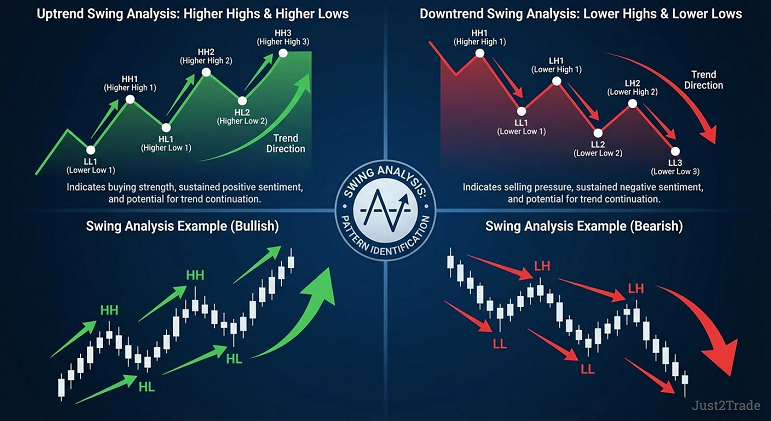
A sequence of rising highs and rising lows can indicate upward structure, while declining highs and lows may suggest downward pressure. Traders can compare these formations across different timeframes because a short intraday move may behave very differently when viewed within a broader daily trend.
Support and Resistance Areas
Repeated reactions around particular price areas can reveal where buying or selling interest has previously intensified. Instead of treating these zones as guaranteed reversal points, traders can observe how price behaves when returning to them, particularly when momentum or trading activity begins changing.
Breakouts and Failed Moves
A price move beyond an established range may attract attention, but crossing a level alone does not confirm continuation. Some traders watch whether price holds beyond the boundary, returns into the range, or produces a failed breakout before determining whether the original move retains credibility.
Multiple-Timeframe Confirmation
A broader chart can establish market direction while a shorter timeframe helps refine execution. This approach can prevent traders from interpreting every small fluctuation as an independent trend, particularly during sessions where rapid intraday movement creates conflicting short-term signals.
Execution Quality Matters When Markets Accelerate
Strong analysis can lose practical value if execution is poorly controlled. During volatile periods, prices can move between the moment an order is submitted and the point at which it is executed. Liquidity and bid-ask conditions also matter because spreads can change as supply, demand, and market participation shift.
Before placing an order, traders may evaluate:
- Current spread conditions and available liquidity
- Distance between entry and intended stop level
- Upcoming economic releases capable of increasing volatility
- Position size relative to account risk
- Whether the setup still matches the original trading plan
Risk Controls Should Be Defined Before the Trade
Index CFDs are leveraged instruments, so comparatively small market movements can have a substantial effect on a position. Leverage can magnify gains as well as losses, making position sizing a central part of risk planning. Traders should determine acceptable exposure before entry instead of deciding how much loss to tolerate after price moves unfavorably.
Stop-loss levels, position sizing, and portfolio monitoring can provide structure to that process. Trading platforms may support these capabilities alongside order management across supported instruments. Such controls do not eliminate market risk, but they can help traders establish predetermined boundaries for individual positions.
Position Size and Market Volatility
Position size can be adjusted according to the distance between entry and invalidation. A volatile market may require wider price tolerance, while a calmer environment can behave differently. Keeping exposure aligned with predetermined risk prevents position size from being chosen purely according to confidence in a setup.
Stop Placement With Market Context
A stop can be positioned around the point where the original trading idea becomes invalid rather than at an arbitrary distance. Structural highs, lows, ranges, and volatility conditions can provide useful context, although rapid markets may still produce slippage during sharp price movements.
Final Thoughts
What separates deliberate index trading from impulsive market participation? The answer often begins with a repeatable process that connects analysis, execution, position sizing, and risk controls instead of treating each decision independently. Traders still face volatility and leveraged-product risk, so platform capabilities should support discipline rather than encourage unnecessary activity.
For traders assessing the best online indices trading platform, Skyriss provides index market access through MetaTrader 5 alongside real-time data, advanced charting, stop-loss functionality, position sizing, portfolio tracking, and demo access. These capabilities give traders practical resources for analyzing broader market movement while keeping execution and risk management within one trading environment.